A NATION’S SPIRIT
A history of Scotch whisky in three volumes
Who it was taken from, who it was handed to, and what the rules were really for.
Register your interest → Read a story ↓
Whisky was a crime before it was a brand
Most histories of Scotch open with a founder and a date on a label.
Whisky was a crime before it was a brand, and when the excise came for it, it was women who stood in front. A Nation’s Spirit traces three centuries of Scotch from croft to boardroom: who it was taken from, who it was handed to, and how Scotland kept the making of its greatest export without ever building the institutions to own it.
I set out to prove my birthright had been stolen and sold. Two years in the excise ledgers, the court records and the company filings later, I’ve reached a different conclusion. Not the one I went looking for, and I think the truer one.Rodryke DW Nicoll
The trilogy
For most of its history, whisky in Scotland was made on farms, by families, without permission. It was not a luxury and it was not a brand. It was a use for barley in a country with too much barley and too little cash, and the people who made it were the people who drank it.
Then it became a crime — not because it changed, but because the state’s reach finally arrived to tax it. And in arriving, the law took the trade from the people who had always made it and handed it to the people who could afford to make it legally.
A Nation’s Spirit follows what happened next, across three centuries and three volumes: the illicit economy and the war against it; the seventy years in which a handful of merchants turned a farm product into the most successful export Scotland has ever had, and were eaten by the thing they built; and the modern reckoning, in which Scotland kept the making of Scotch and never built the institutions to own it, to govern it, or to say what was in it.
It is not a story of England against Scotland. At every turn the decisive hands are Scottish ones — landlords, merchants, executives, trade bodies — trading a productive asset for admission to a larger system. The distilleries that closed in the 1980s were closed by Scotsmen.
The books are built from the archive rather than the brand: excise records, court testimony, parliamentary debate, company filings, newspaper reports. Where the evidence conflicts, the conflict is printed. Where a story is only a story, it is told at full length and then taken apart.
The volumes
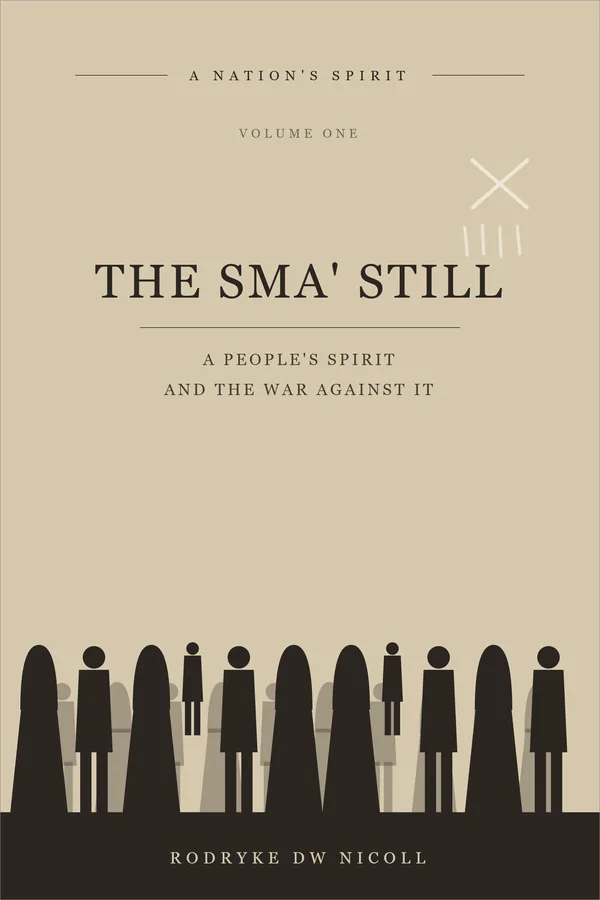
Volume One
THE SMA’ STILL
A People’s Spirit and the War Against It
c.1644 – 1840
A farm product became a crime. The women led the resistance, and the record that proves they led calls them rash for it.
A thing made on a farm from barley, water and peat smoke became a crime. This is the world it was made in and the machinery built to end it: the excise officer and the informer’s half-share, the landlord made liable for his own tenants, the punishments that fell hardest on those who could not pay a fine. It is also the volume in which the women are put back — a fifth of one Campbeltown still-maker’s customers were women, and when the excise fired on a crowd at Kilmory in 1817, most of the two hundred people facing them were women, led by one. The trade did not end because the penalties grew fiercer. It ended because in 1823 the licence got cheap — and cheap was still far beyond the reach of the people who had been making it.
Forthcoming
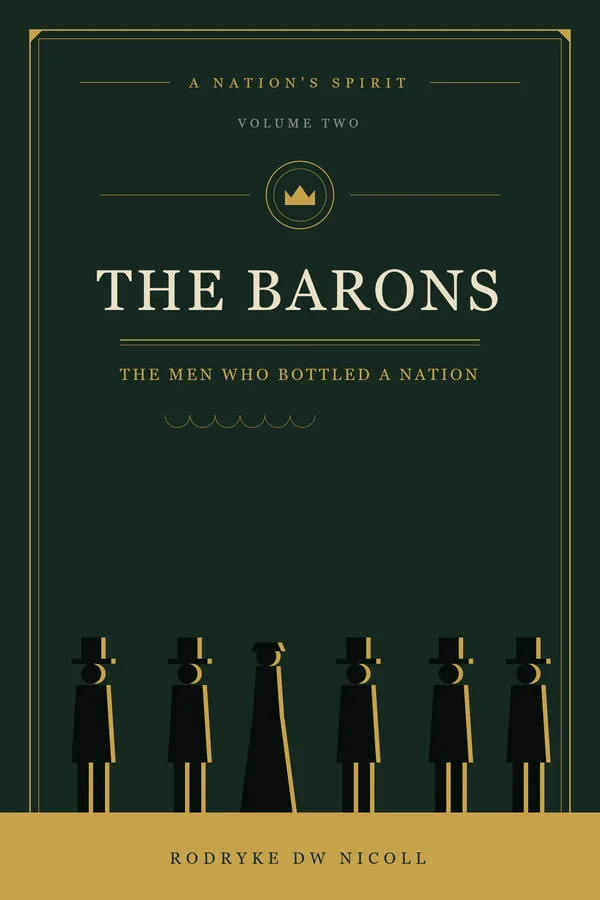
Volume Two
THE BARONS
The Men Who Bottled a Nation
1830 – 1925
Seventy years to turn a regional spirit into a global one. The women were moved out of the making, into the bottling hall, and onto the other side of the argument.
The men handed the trade in Volume One spent seventy years making it worth having. A continuous still, a blending vat and an empire’s shipping lanes turned a regional spirit into a global one. Walker, Dewar, Buchanan and Mackie built brands that outlived them, invented their own antiquity while they were doing it, bought their way into Parliament and the peerage, and were consumed one by one by the combine they had spent their careers feeding. Between them stands the Pattison crash of 1898 — the moment the boom’s own bookkeeping came apart — and behind them, accumulating quietly under every chapter, the Distillers Company.
Forthcoming
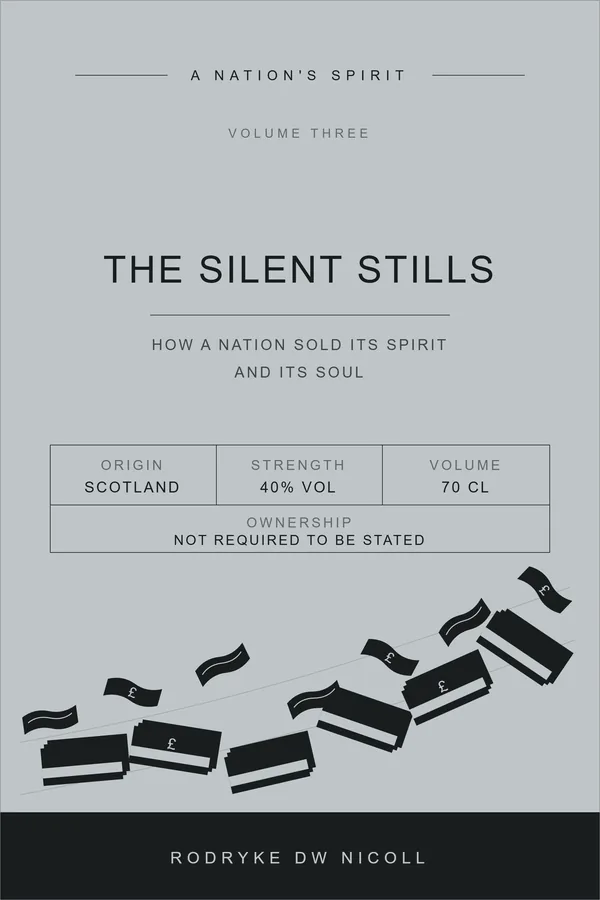
Volume Three
THE SILENT STILLS
How a Nation Sold Its Spirit and Its Soul
1945 – present
The closures, the sale, and the finding: Scotland kept the work and never built one institution able to say who owns it. A few families held on. The book ends on why so few.
The industry filled its own warehouses, and then emptied its own villages. Between 1983 and 1993 the closures came in waves — Port Ellen, Brora, Dallas Dhu, St Magdalene, Rosebank — and the company that ordered most of them was Scottish and had been for a century. The sale that followed made Scotch the property of firms headquartered elsewhere, and the argument of this volume is not that Scotland was robbed. It is that Scotland was never governed: a nation that retained the work, the water, the warehouses and the name, and never built a single institution capable of owning the thing, ruling on it, or saying what could go in the bottle. That is worse, harder to argue with, and nobody’s fault in a way that makes it everybody’s.
Forthcoming
From the trilogy
Steaming
In 1853 Parliament closed Scotland’s pubs on Sundays and accidentally made distance alcoholic. Nine days later, three hundred and fifty Glaswegians stormed a fortified pier on the Gareloch with potatoes, coal and dinner plates.
Read a story
STEAMING
The Battle of Garelochhead, 1853
Every country has a word for being spectacularly drunk. The English get plastered, which sounds like building work. The Americans get hammered, which is joinery. Scotland, naturally, went to sea.
Steaming. Or, properly, steamin’. Absolutely steaming. It is a magnificent word because it suggests much more than simple drunkenness. A man who is steaming is under power. The boilers are lit, smoke is coming off him and he is proceeding at considerable speed towards a destination that may not have been fully considered. Drunk sounds impaired. Steaming sounds operational. There is almost admiration in it.
There is a story about where the word came from, and like all the best Scottish stories it involves religion, alcohol, a badly thought-through piece of legislation and several hundred men who were not going to allow Parliament to interfere with their Sunday.
The version I had always heard was simple. In the nineteenth century Scotland was drinking itself into the ground and the temperance movement finally persuaded Parliament to shut the pubs on Sundays. Travellers, however, were exempt. Some enterprising Glaswegian realised that if you bought a ticket on a Clyde steamer, you were no longer a Glasgow man looking for a drink. You were a traveller. So hundreds of men started taking Sunday trips down the Clyde, got comprehensively drunk and returned to Glasgow that evening on the steamers.
Hence steaming.
It’s a great story. Unfortunately, it’s not quite true.
The good news is that the truth is much better.
The law arrived in 1853. The Licensing (Scotland) Act received royal assent on 12 August and became universally known as the Forbes Mackenzie Act after William Forbes Mackenzie, the temperance-minded politician who drove it through.
Mackenzie deserves a brief mention because history occasionally provides a joke so complete that adding anything merely gets in the way. He was a Conservative, a temperance man and a Scotsman who happened to have been born in Exmouth in Devon. Better still, seven weeks before his Act became law, he had been thrown out of Parliament after his election agents were found guilty of bribery and treating. Treating, in nineteenth-century electoral language, meant buying voters food and drink.
So the man whose name became attached to stopping Scots buying a drink on Sunday had recently lost his parliamentary seat partly because his own side had been buying men drinks.
You have to admire the symmetry.
The Act closed Scotland’s public houses on Sundays, but it didn’t actually ban alcohol. That would have been far too straightforward. Instead it prevented licensed premises from serving local inhabitants. Hotel residents could still be served and, crucially, so could a bona fide traveller.
And there it was.
Parliament had accidentally made distance alcoholic.
Stay in Glasgow and you were a local inhabitant who could not legally be served. Travel far enough down the Clyde and you became a bona fide traveller. Nothing about you had changed. Your thirst certainly hadn’t. But in the eyes of the law you had undergone a transformation.
The government had not stopped Sunday drinking. It had introduced a journey requirement.
On the Clyde in 1853 that was not much of an obstacle. Pleasure steamers had already been carrying people down the river for decades. The boats existed, the piers existed and, most importantly, the towns at the other end contained hotels.
Four Glasgow businessmen spotted the opportunity. Andrew Paton, a merchant; Thomas Maclaurin, a coalmaster; Robert Meggett, a muslin manufacturer; and Andrew Rowley, a drysalter. A merchant, a coalmaster, a muslin manufacturer and a drysalter sounds like the beginning of a joke, but between them they had an elderly Gareloch steamer called the Emperor.
On Sunday mornings she left the Broomielaw at around quarter past nine and sailed down the Clyde, calling at Renfrew, Bowling, Greenock, Gourock and Helensburgh before running up the Gareloch. She was licensed to carry 480 passengers and frequently carried the lot, sometimes leaving another hundred standing at the piers because she was full.
Four hundred and eighty Glaswegians simultaneously developing an urgent desire to travel on the one day their local pubs were shut.
But here is the detail that makes the whole story.
The Emperor didn’t sell drink.
Not a drop.
There was no bar below decks, no barrels of whisky and no wee swally as Glasgow disappeared behind you. Her owners were careful about that because they weren’t selling alcohol.
They were selling an alibi.
A man stepped aboard at the Broomielaw as a local inhabitant. A journey down the Clyde later, he stepped ashore as a bona fide traveller and could walk into a hotel and legally order a drink.
The steamer owners sold the distance. The hotels sold the whisky. Everybody understood the arrangement.
Everybody except, perhaps, Sir James Colquhoun of Luss.
Sir James owned the piers at Garelochhead and had strong views about hundreds of Glaswegians arriving on the Sabbath to take advantage of the new law. The Emperor had already landed there once on a Sunday without serious incident, but she was advertised to return on Sunday 21 August 1853, only nine days after the Act received royal assent.
Sir James decided they would not be landing again.
He did not content himself with putting up a notice.
He fortified the pier.
Across its full width his men constructed a barricade from barrels, herring boxes and planks, with a large cattle gangway lashed into the structure. Behind it he assembled somewhere between thirty and forty gamekeepers, gillies and estate servants armed with staves. County police had been sent up that morning as well.
All this to stop men getting ashore for a drink.
Word spread.
By lunchtime the banks of the Gareloch were lined with spectators. People had walked considerable distances because they’d heard there might be trouble. This was 1853. There was no television, radio or internet. If someone told you 350 Glaswegians were arriving by paddle steamer and a local baronet had built a fortification to stop them reaching the pub, that was your afternoon sorted.
At twenty minutes past one the Emperor appeared carrying around 350 passengers.
And, as if the scene required any further assistance, divine service was underway in the village church.
Inside, the congregation was observing the Sabbath.
Outside, thirty or forty men with staves stood behind a barricade while a paddle steamer carrying 350 increasingly determined bona fide travellers came towards the pier.
The banks were lined with spectators.
You could not have staged it better.
The Emperor came alongside and the ropes were thrown ashore. Nobody would make them fast. Men from the steamer therefore jumped down and began securing the vessel themselves.
That was the first breach.
One of Sir James’s gamekeepers, Archibald Colquhoun, stepped forward with a clasp knife and attempted to cut the hawser.
That was the second.
And that appears to be where the afternoon stopped being a dispute over licensing law.
The passengers surged forward.
They were not armed in any organised sense. Nobody had boarded the Emperor that morning expecting to conduct a military landing. But 350 excursionists carried plenty of things capable of acquiring a secondary purpose.
Potatoes were thrown. Turnips followed. Coal was picked up and hurled towards the defenders. Bottles flew through the air.
Then the dinner plates.
I love the dinner plates.
Somebody had presumably left Glasgow that morning expecting a pleasant Sunday excursion and had packed lunch properly. Sandwiches perhaps. Something wrapped in paper. A plate, because standards matter.
Then, several hours later, faced with an armed barricade between himself and a legal pint, he looked at the crockery and thought: ammunition.
There is something deeply reassuring about a riot in which root vegetables and tableware form part of the opening barrage.
Sir James’s men responded with their staves. The passengers pressed forward from the steamer and the pier became a proper fight. Men were struck, grabbed, pushed backwards and knocked against the barricade. Stones, coal, vegetables and bottles continued to fly while the spectators watched from the banks and the police discovered that their normal training had not covered amphibious assaults by Glaswegians carrying lunch.
The defenders had the obvious advantages. They held the pier, they had a barricade and they had weapons.
They also had perhaps forty men.
The Emperor had 350 passengers.
Numbers began to tell.
One contemporary account has the front rank of Sir James’s men disarmed within about five minutes. Staves were taken from them and immediately changed ownership. Men who moments earlier had been defending the barricade found themselves being pushed back over it, assisted in some cases by a boot applied to the seat of the trousers.
Then the passengers attacked the barricade itself.
The cattle gangway was cut loose. Barrels were rolled aside or pushed into the loch. Herring boxes followed. Planks were torn away. The outer gate was stove in.
Imagine the noise. A paddle steamer pressed against the pier, hundreds of men shouting, wood breaking, bottles smashing, barrels rolling, spectators cheering from the shore and, somewhere nearby, a church service trying to proceed as though the Sabbath remained under control.
The barricade gave way.
The passengers had taken the pier.
Three hundred and fifty Glaswegians had travelled down the Clyde on a Sunday, encountered a fortified position defended by armed estate workers and police, attacked it with vegetables, coal, bottles and dinner plates, disarmed the front rank and captured their objective.
The objective being access to the hotel bar.
And then, having successfully smashed through the barricade and forced the gate, they apparently refused to use the gate to come ashore.
On principle.
Instead they climbed down by ladder.
That detail may be my favourite of the whole story. Once you’ve had to fight your way onto the pier, simply walking through the gate apparently concedes too much. The battle had developed rules of its own.
The Glasgow Sentinel, which was firmly on the side of the excursionists, added another detail which turns the entire episode into something approaching perfection. Some of the men defending the pier had apparently been fortified beforehand with whisky.
So consider where the great experiment in Scottish temperance had arrived only nine days after the Act became law.
Parliament had restricted Sunday drinking. Hundreds of men had immediately discovered that travelling allowed them to drink. A landowner had raised a small private army to stop them travelling. That army had allegedly been given whisky before fighting men who were attempting to reach whisky.
Both sides were now engaged in a pitched battle over Sunday drinking and at least one side had been drinking in preparation for it.
Meanwhile divine service continued nearby.
There are limits to satire.
Nobody was killed, although several people were injured. Having won the Battle of Garelochhead, the passengers finally achieved the objective for which the entire campaign had been conducted.
Both inns were open.
Of course they were.
The passengers had around two hours ashore before the Emperor was due to return to Glasgow and the hotels did exceptional business. One witness remembered the expression on the hotel keeper’s face: the biggest day’s trade of his life conducted with the expression of a man attending a funeral.
Then the men returned to the steamer and sailed back to Glasgow.
You might imagine that everyone involved would have regarded this as enough excitement for one licensing dispute.
They came back the following Sunday.
Sir James had also spent the week considering his position.
His first barricade had failed, so he escalated. He had sections of planking removed from the wooden wharf and spikes driven into the outer edge, apparently intended to damage the Emperor‘s paddle wheels if she attempted to come alongside.
This was no longer simply opposition to Sunday drinking. Sir James was modifying maritime infrastructure.
The Emperor arrived and used the old stone pier instead.
So the following week Sir James barricaded both piers.
The steamer’s side responded with tactics of its own. A boat’s crew was sent ahead to the stone pier while the Emperor took a leisurely turn around the loch. The advance party dismantled the barricade before Sir James’s men properly realised what was happening.
By the time the steamer returned, the barricade was floating down the Gareloch to cheers from the passengers.
Sir James escalated again.
He began trying to blow up the old quay.
At this point it is worth remembering where all of this started.
A law said you couldn’t buy a drink in your local pub on Sunday.
So you got on a boat.
Someone barricaded the pier.
You stormed the barricade.
He put spikes in the pier.
You used another pier.
He barricaded that one.
You sent an advance party to remove the barricade.
He started destroying the pier.
At no stage did anyone appear to consider the alternative of simply not having a drink on Sunday.
Eventually the matter went where all good Scottish disputes go once vegetables, staves and explosives have failed to resolve them.
The Court of Session.
In December 1853 Sir James sought an interdict to stop the Sunday landings. You might expect the judges to grapple with the great moral issues raised by the case: Sabbath observance, temperance, public order, private property and the rights of several hundred Glaswegians to arrive unexpectedly at your pier.
Instead Sir James lost because he had put up a price list.
He had displayed a table of dues showing the public what they were required to pay to use the pier. The Lord Justice-Clerk’s reasoning was beautifully narrow: if you publicly advertise the charge for using something, it becomes rather difficult to maintain that the public has no right to use it.
After barricades, a pitched battle, spikes and the beginnings of demolition, Sir James was defeated by his own tariff.
It took him until 1859 to finally obtain the legal result he wanted. A different argument succeeded and the excursion steamers were pushed away from his private piers.
So they went to Greenock, Gourock, Largs and Rothesay instead.
Places with plenty of hotels.
Sir James eventually won control of his piers and lost the wider argument completely. The passengers simply changed destination.
Over the following decades the Sunday excursion trade changed again. Fares fell, more people travelled and eventually the drink itself came aboard. Some steamers developed reputations as floating public houses. What had started as transport required to reach a legal drink gradually became somewhere to have the drink.
By the 1880s legislation caught up with that as well and passenger vessels were brought under licensing control.
Which brings us back to the word.
Did steaming really come from those Clyde steamers?
I want it to.
It fits too perfectly.
Unfortunately history becomes awkward at exactly the point where the story needs a clean ending. We can document the Forbes Mackenzie Act. We know when the Emperor sailed. We know the names of her owners, her capacity and her route. The Battle of Garelochhead appeared in contemporary newspapers. We know the barricade was built from barrels, herring boxes, planks and a cattle gangway. We know the passengers threw potatoes, turnips, coal, bottles and dinner plates. We have the court cases.
What we do not have is a Victorian Glaswegian writing down that his mate was steaming in the modern sense.
The recorded Scottish use of steaming to mean comprehensively drunk appears much later. There is an irritating gap between the nineteenth-century steamers and the twentieth-century slang, and pretending otherwise would make the story neater but not truer.
Perhaps the word came from the boats. Perhaps it developed somewhere else and the Clyde story attached itself afterwards because it fitted so beautifully.
I am happy to leave that argument to people who enjoy footnotes more than pubs.
Because whatever happened to the word, the behaviour is beyond dispute.
And there is one final newspaper report from 1853 that deserves the last word.
The Greenock Advertiser carried a small item under the heading Going to bed after a Sunday excursion. A constable walking his beat in the Trongate sometime between Sunday night and Monday morning noticed a small white mound lying in a close.
It was a dress shirt, still warm. Underneath it was a waistcoat, then a pair of trousers and the remainder of one gentleman’s Sunday suit.
The constable looked around the close for the man.
He was nowhere to be found.
From A Nation’s Spirit. Free Rein Press.
Publication
| Volume One — The Sma’ Still | Date to be announced |
| Volume Two — The Barons | Date to be announced |
| Volume Three — The Silent Stills | Date to be announced |
Hardback and ebook. Distributed to the trade via IngramSpark / Gardners.
Register your interest
Be told first
The volumes are in preparation. Leave your details and you will be told the publication date before it is announced anywhere else, with first refusal on the print run and an extract ahead of publication. Nothing is charged and nothing is committed.
Your details are used only to tell you about this trilogy. They are not sold, shared or added to any other list, and you can ask to be removed at any time by writing to hello@freereinpress.com.
The author
Rodryke DW Nicoll is not a historian. He is a drinks man with a research habit that got out of hand.
For ten years his job was to make something that tasted like whisky without being whisky. It is a peculiar education. You cannot counterfeit a thing convincingly until you understand exactly what it is — where it came from, why it’s made that way, and which parts are chemistry and which are simply story.
Before that came a working life in the Scottish licensed trade; behind it lies his father Watt’s unpublished research from when he created the play Scotch for the Edinburgh Festival, which forms the spine of these three volumes.
He lives in Glasgow. Writing as Roddy Nicoll, his last book was about his family. This one is about everyone else’s.
Free Rein Press
Free Rein Press is a small independent publisher based in Glasgow. It publishes memoir, food writing, craft and narrative history — books made carefully, in small numbers, to a standard the trade takes seriously.
The press publishes under its own ISBNs and distributes to bookshops and libraries through the book trade. More from the press